
Uncompromised Integrity. Absolute Independence.
While the ICRG is primarily funded by the gaming industry, our research remains shielded by a bias-proof scientific firewall that eliminates outside influence.
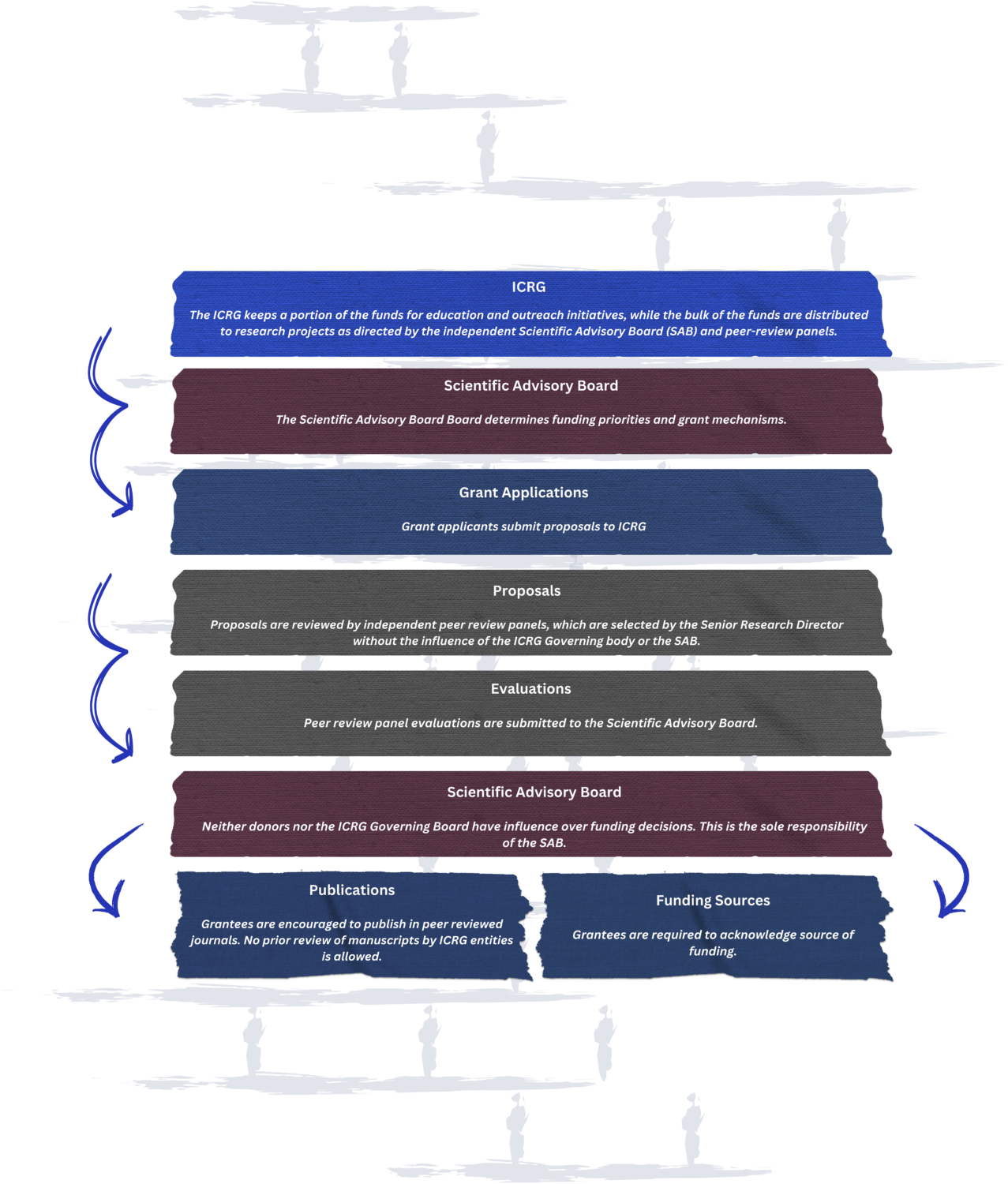
As the foundation of our rigorous research process, the ICRG firewall establishes four tiers of insulation for funded research, ensuring that every discovery is objective and independent.
- Scientist-Led Initiatives: All funding priorities are developed exclusively by our Scientific Advisory Board—an independent panel of the world’s leading addiction experts.
- Global Competition: We cast a wide net, distributing calls for proposals to over 1,000 scientists across the globe to ensure the brightest minds are on the case.
- Double-Blind Rigor: Every application undergoes a vetting process by independent peer-review panels composed of expert researchers in the gambling field.
- Zero Donor Input: Final funding decisions rest solely with the Scientific Advisory Board. Neither our donors nor our governing board have any say in who receives a grant or what the research reveals.
Our commitment to science first is validated by the numbers. Since 1996, ICRG-funded investigators have published more than 400 articles in peer-reviewed journals. We don’t announce findings until they have survived the scrutiny of the global scientific community—proving that at the ICRG, quality is what drives our mission.
ICRG Firewall
Grant Review Criteria
The ICRG funds high-impact research destined for the world’s leading scientific journals and conferences. To ensure excellence, our independent peer-review panels evaluate every proposal using rigorous criteria adapted from the National Institutes of Health (NIH):
- Strategic Impact: We prioritize research that breaks new, innovative ground.
- Does it matter? We look for projects that tackle critical barriers or solve significant problems in the field.
- Will it move the needle? Successful proposals must demonstrably advance scientific knowledge, clinical practice, or preventive interventions.
- Is it forward-thinking? We value innovative concepts that refine or replace outdated methodologies.
- Rigor and Feasibility: Brilliant ideas must be backed by a flawless execution plan.
- Scientific Integrity: Is the methodology robust enough to yield reproducible results?
- Problem Solving: Are potential pitfalls identified and alternative strategies in place?
- Ethics: For clinical research, are human subject protections appropriate and justified?
- Expertise and Environment: We invest in the people as much as the project.
- The Team: Are the investigators uniquely qualified, with clear leadership and complementary skills?
- The Infrastructure: Does the institutional environment provide the necessary equipment, resources, and collaborative support to guarantee success?
Peer Reviewers
The following scientists reviewed grants applications for the ICRG in 2024:
Brian Borsari, PhD
Professor of Psychiatry
University of California-San Francisco Weill Institute for Neurosciences
Bethany Bray, PhD
Associate Professor
Department of Medicine
University of Illinois at Chicago
Luke Clark, PhD
Professor of Psychology
Director of the Centre for Gambling Research
University of British Columbia
Heather Gray, PhD
Assistant Professor, Harvard Medical School
Director of Academic Affairs at the Division on Addiction
Cambridge Health Alliance
Joshua Grubbs, PhD
Associate Professor
Bowling Green State University
Scott Huettel, PhD
Professor in the Department of Psychology and Neuroscience
Bass Fellow
Professor of Neurobiology
Duke University
Debi LaPlante, PhD
Associate Professor of Psychiatry, Harvard Medical School
Director, Division on Addiction, Cambridge Health Alliance
Matthew Martens, PhD
Associate Provost for Academic Programs
University of Missouri, Columbia
Dipali Rinker, PhD
Assistant Professor
Behavioral Sciences and Population Health
American University of the Caribbean School of Medicine
Paul Sacco, PhD
Associate Professor of Social Work
University of Maryland, Baltimore
Nathan Smith, PhD
Executive Director
Kindbridge Research Institute
Krishna Vaddiparti, PhD
Assistant Professor of Epidemiology
University of Florida
Jeremiah Weinstock, PhD
Professor, Clinical Program
Department of Psychology
Saint Louis University
ICRG Policy on Academic Integrity and Research Misconduct
“Research misconduct is defined as fabrication, falsification and plagiarism, and does not include honest error or differences of opinion.” (ORI 2005)
ICRG is committed to ensuring the academic integrity of all research funded with its grants. ICRG conducts multiple reviews of grant applications and related proposals every year. Peer reviewers who believe they have identified research misconduct in the form of fabrication, falsification or plagiarism are required to alert ICRG’s Senior Research Director immediately upon such concern. The allegation must not be discussed during peer review, and the reviewer making the allegation will be reminded of the ICRG policy on confidentiality. An application flagged for possible misconduct will still be put through the peer review process.
Within 30 days of being alerted to possible misconduct, the Senior Research Director will convene a meeting of the Scientific Advisory Board (SAB) to discuss the allegation. The Senior Research Director will be required to assess any conflicts of interest within the SAB prior to the meeting.
Within 30 days of such meeting, the SAB will decide by at least a two-thirds/majority vote of all of its then members if the alleged misconduct should be reported to the grant applicant’s institutional office of research integrity. Alleged misconduct must be deemed egregious in the eyes of the SAB to be so reported. The Senior Research Director will then be solely responsible for any communications with the applicant’s institution on behalf of ICRG.
NIH Office of Scientific Integrity Definitions for purposes of this Policy: Fabrication: Making up data or results and recording or reporting them. Falsification: Manipulating research materials, equipment, or processes, or changing or omitting data or results such that the research is not accurately represented Plagiarism: The appropriation of another’s ideas, processes, results, or words without giving appropriate credit
References:
Handling Misconduct | ORI – The Office of Research Integrity. (2005). The Office of Research Integrity. https://ori.hhs.gov/handling-misconduct
Eisner, R., & Vasgird, D. (2003). Responsible Conduct of Research : Research Misconduct. https://Ccnmtl.Columbia.Edu/Projects/Rcr/Rcr_misconduct/WinResources.Html.
Research Transparency Statement
The International Center for Responsible Gaming (ICRG) provides funding for scientific research using donations from commercial and tribal gaming companies, equipment manufacturers, vendors, ICRG Governing Board members, and the community at large. ICRG utilizes the following safeguards to ensure ethical and rigorous science:
- A Scientific Advisory Board (SAB)
- The SAB sets research priorities, determines funding mechanisms, and makes final funding decisions without donor input (Cottler et al., 2016a)
- The SAB independently selects its own members—neither the ICRG Governing Board nor industry donors have any role in these appointments, and SAB members must declare any conflicts of interest with industry donors on an annual basis.
- SAB members volunteer their time and are not financially compensated.
- SAB members are prohibited from applying for, or participating in, ICRG grants.
- Firewall Between Donors and Researchers
- The ICRG Governing Board and donors do not participate in shaping research agendas, reviewing or selecting proposals for funding, or influencing publication decisions from funded research.
- Grantees maintain academic freedom to design, conduct, and publish their work without restriction or interference by ICRG, the Governing Board, donors, or the SAB.
- Rigorous Peer Review and Open Calls
- Calls for proposals are open to researchers worldwide, encouraging diverse perspectives, methods, and expertise.
- All proposals undergo a rigorous peer review process by independent experts (see https://www.icrg.org/information/our-process/).
- Funding decisions reflect scientific merit (Cottler et al., 2016a).
- Transparency in Funding Acknowledgments
- ICRG grantees are required to acknowledge ICRG funding in publications as part of their funding agreement (Cottler et al., 2016b).
- Commitment to Open Science and Risk-of-Bias Monitoring
- ICRG encourages all funded researchers to adopt Open Science practices, including project pre-registration, data sharing (where ethical and feasible), and transparent reporting.
- We endorse the development of instruments to detect and mitigate funding-related bias.
By adhering to these guidelines, the ICRG strives to maintain a robust firewall between industry funding and the scientific process, upholding the highest standards of research integrity and accountability (Cottler et al., 2016a; 2016b).
References
- Cottler LB, Chung T, Hodgins DC, Jorgensen M, Miele G. (2016a). The NCRG Firewall Works. Addiction.
- Cottler LB, Chung T, Hodgins DC, Jorgensen M, Miele G. (2016b). Correcting the record on NCRG-funded research. Addiction.